International
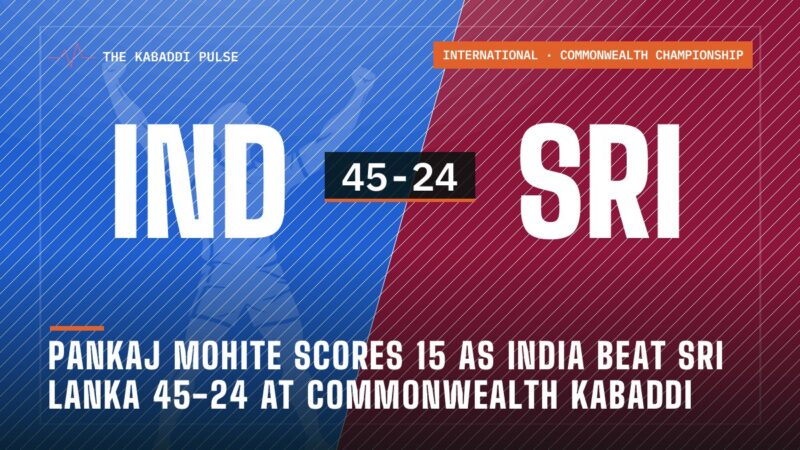
Pankaj Mohite scores 15 as India beat Sri Lanka 45-24 at Commonwealth Kabaddi
India topped their group with six wins from six as Mohite and Aditya Shinde led the raiding. Bangladesh and Kenya also posted huge wins.
Tanzania's captain at the Commonwealth Kabaddi Championship puts most of his earnings into a club of about 200 children, because there are no sponsors or government support.
Masudi Omary, the captain of Tanzania at the inaugural Commonwealth Kabaddi Championship in Ahmedabad, puts most of what he earns into a kabaddi club for children back home. He does it because, as he told The Bridge, the sport in his country has no sponsors and no government support.
Omary is the chairman of the Kaole Kabaddi Sports Club in the coastal town of Bogomoyo, where about 200 children have taken up a sport that remains largely unknown in the East African nation of nearly 73 million people. According to The Bridge, those children gather in front of a television set every day for about 40 minutes to watch their mentor play.
“I’m the chairman of my own club,” Omary said. “In the club, I’m trying to pick up kids from schools and develop kabaddi from the grassroots in Bogomoyo. We have about 200 kids in the club and I motivate them to play kabaddi.”
With no funding for kabaddi in Tanzania, Omary pools the majority of his income into the club to keep the sport going. He works a job alongside his kabaddi commitments and also coaches.
“I juggle a job and once I get paid, I provide for my players,” he said. “There are no big tournaments in our country for kabaddi and that is why there are no sponsors and government support.”
Beyond training the children, Omary organises inter-school tournaments to give them competitive exposure. He also runs a non-governmental organisation called “We are stronger together”, which works with children and people living with HIV/AIDS and other vulnerable groups in Tanzania.
Kabaddi in Tanzania dates back to 2016, when circle kabaddi, the Punjab style of the game, was introduced in the country. The country now has a total of eight kabaddi clubs.
Omary came to the sport in 2019 after limited success as a footballer, drawn by the athleticism it demands. Seven years later he leads the national team. The 2026 Commonwealth Championship, held under the aegis of the IKF and AKFI, is the first international tournament outside the African Kabaddi Championship for Omary and his side.
Results at the Veer Savarkar Sports Complex have been hard to come by. Tanzania won just one of their five matches, and the squad arrived after only a two-week camp.
“We had a two-week camp before we came to India,” Omary said. “We are not satisfied with our performance but we are trying. We are trying to learn some advanced skills to develop more and more.”
The tournament also gave Tanzania their first meeting with India. “We played with India for the first time,” he said. “We lost, but we were impressive.”
He sees the trip as a starting point. “Once we go back to Tanzania, there’s a lot of things which we can discuss with our fellow players so that we can develop kabaddi further,” he said.
Asked what has kept him in the sport for seven years despite the lack of backing, Omary pointed to the demands of the game itself.
“It is a fun game,” he said. “Once you play kabaddi, you have to be physically and mentally strong.”
“Kabaddi eats our own blood and that’s why we play it day in and day out.”
There is a cultural link too. Movements in kabaddi closely resemble those of Ngoma, the traditional Tanzanian drumming, music and dance form. Omary is himself a dancer and a drummer.
“I’m a dancer and play the traditional drum. The steps are very similar and that’s why I like the sport,” he said.
With Kenya and Uganda already making strides in kabaddi, The Bridge noted that Omary’s enthusiasm could help Tanzania become another rising African nation in the sport, provided it receives the right guidance, opportunities and financial support. When the squad returns from Ahmedabad, Omary plans to take the lessons of the tournament back to his players and the children of Bogomoyo.
This article was written with AI assistance from the sources listed above and checked against them. Our editor reads everything we publish and corrects it where needed. Our editorial standards
India topped their group with six wins from six as Mohite and Aditya Shinde led the raiding. Bangladesh and Kenya also posted huge wins.
Shubham Shinde led a disciplined defence as India inflicted six all-outs in Ahmedabad to make it five wins from five and seal a semifinal place.
Lavenda Odhiambo scored 16 as Kenya inflicted eight all-outs. Malaysia, Bangladesh and Canada also won by big margins on day five.