International
Pawan Sehrawat missing as India name 17 probables for Commonwealth event
AKFI's 17-man camp list for the inaugural Commonwealth Kabaddi Championship in Ahmedabad leaves out every member of India's Asian Games 2026 gold medal squad.
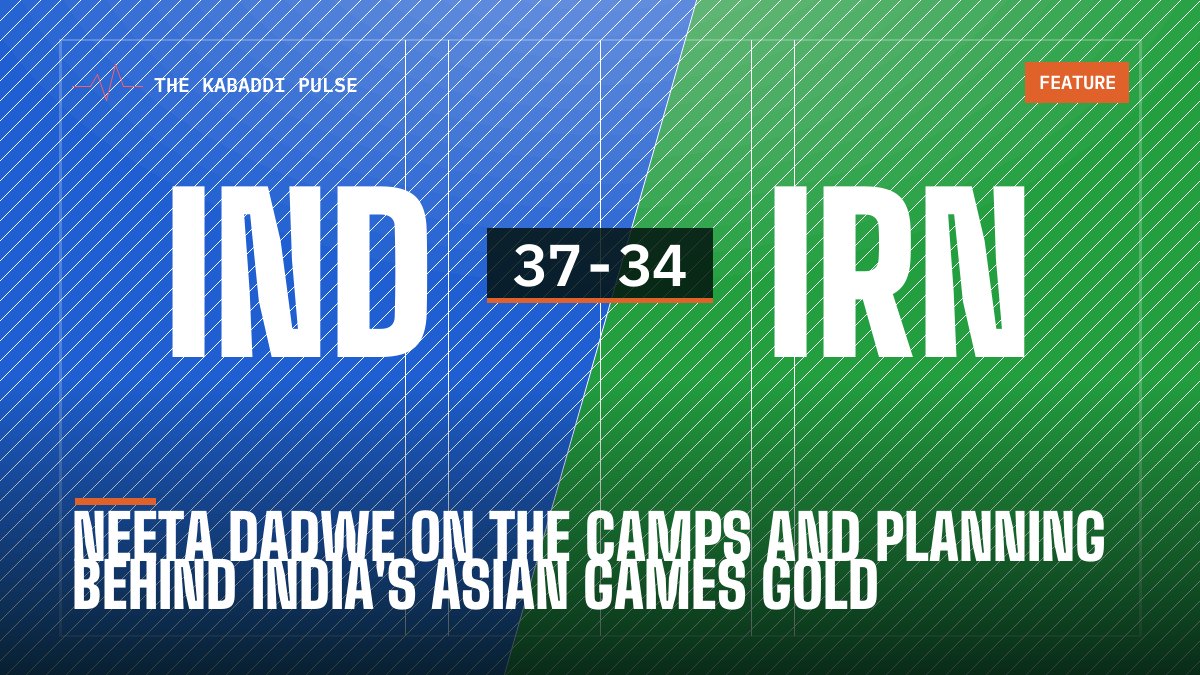
India's women's kabaddi coach explains how three camps, a phone ban and footage of Iran's own training led to a 37-34 final win and a retained Asian Games title.
Neeta Dadwe, the coach who guided India’s women’s kabaddi team to gold at the Asian Games in Aichi-Nagoya, Japan, has put the triumph down to months of carefully planned camps, a strict no-mobile-phones rule and close study of Iran’s own preparation. She spoke to The Hindu at her home in Hyderabad, a day after landing to a roaring welcome at the city’s airport.
India beat Iran 37-34 in a closely fought final, defending the gold they won at the Hangzhou edition in 2022. For Neeta, an Arjuna Awardee who reinvented herself as a coach after a stellar playing career, it was a second Asian Games gold from the dugout. She also guided the national side to gold at the 2014 Asian Games and at the 2016 South Asian Games.
Her home sits in a quiet Hyderabad bylane that is also home to P.V. Sindhu, Koneru Humpy and former cricketer Venkatapathy Raju. Inside, a cabinet of medals and trophies tells its own story. “Kabaddi gave me this house. Everything you see here is what the sport has given me. All of it is a result of my hard work,” Neeta said.
Captain Pushpa Rana, all-rounder Jyoti Thakur and several other players said after the final that the groundwork for the title was laid at the training camps. Neeta explained how they were set up.
“Our first camp was at SAI Gandhinagar in May for one month. We had 42 girls and brought it down to 29 there,” she said. She called the cut a tough task for the selection committee, which included Mamata Poojary and V. Tejeswini Bai. A second camp of 15 days followed, again at SAI Gandhinagar, and the third was held at the JSW facility in Ballari.
The support on offer was a step up from what she had in 2014. “We got stuff like a fitness trainer, masseur, sauna bath, ice bath, and more, which is not common for us in kabaddi. I was the coach in 2014 (Asian Games) and we didn’t have as many facilities as we got this time. The kids were very happy because our camps were like international ones. And because of that, for probably the first time, we barely had any injuries during the tournament.”
Alongside physical and mental training, video analysis and tactical sessions, the squad gave up their phones. “We asked the federation and got their permission to do it. The more you use your mobile, especially later in the night, the more you will feel tired the next day,” Neeta said. Players took turns collecting the phones, which were handed back on Saturday and returned by the end of Sunday.
What the camps could not prepare the team for was the accommodation in Japan. The Indian contingent was housed on a docked cruise ship, and Neeta did not hide the difficulties.
“The schedule was very tight for us, and the ground was very far from the ship where we were put up. To be honest, not everyone fits [in the accommodation provided] on the ship. Food was also an issue. Non-vegetarians didn’t have a problem, but the vegetarians faced many. However, the girls managed to face it all without many complaints,” she said. Bread became a staple of her own diet.
On the mat, India breezed past their group-stage opponents and beat Nepal in the semi-final before meeting Iran. India started brightly and led 5-2, but Iran levelled with a super tackle and went ahead 7-5 in what became India’s closest contest of the Games.
The Indian Olympic Association, led by president P.T. Usha, was in the stands. “P.T. Usha came to watch our match. The whole of IOA came. We were all very tense. I was so tense that I couldn’t even look back [at the stands],” Neeta said.
Part of India’s edge came from Iran’s own build-up. “They had been practicing in India for two months. They were in Himachal, played with two or three clubs in Haryana. We asked the federation for some of their videos, and we studied them well,” she said.
Neeta was assisted by Mamata, whom she had coached extensively, including at the 2014 Asian Games. “We used to sit at night and map on a piece of paper who should be played where. And on the first day there, neither of us slept because we were tense. If we used Ritu Negi in the corner pool, then they [the opponents] would’ve made a strategy for it. So we changed things up to give others some food for thought,” she said. “We were not playing for our States or for Railways or anything. We were representing India.”
Asked to weigh this title against 2014, Neeta replied: “Zameen aasman ka farak hai” (a world of difference). She pointed to India’s record of gold in 2010, 2014 and 2022 and silver in 2018, and to how much the competition has grown.
“In 2018, Iran edged India narrowly in the final. They were coached by our very own Shailaja Jain, who taught them exactly how to play against us. Also, there is a lot more competition now. Look at how well Nepal did. No one expected that.”
Having done both jobs at the highest level, she knows which one is easier on the nerves. “A player and a coach are different. A player gets to enjoy more; I was one, I know it very well,” she said.
AKFI's 17-man camp list for the inaugural Commonwealth Kabaddi Championship in Ahmedabad leaves out every member of India's Asian Games 2026 gold medal squad.
Pushpa Rana, Jyoti Thakur and Bhawna Thakur met Sukhvinder Singh Sukhu after an initial Rs 33 lakh offer left them disappointed. They will also get government jobs.